
Book Review: The Lifelong Gardener
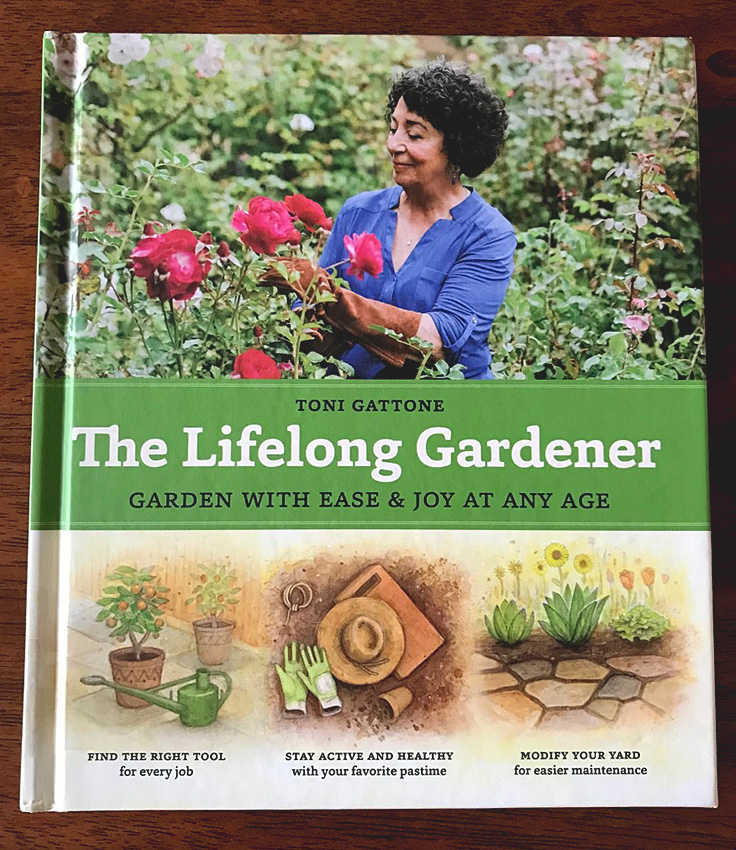
Book review: The Lifelong Gardener: Garden with Ease & Joy at Any Age by Toni Gattone (Timber Press, 214 pp., $19.95)
While at this year’s Garden Communicators’ conference in Salt Lake City, I met Toni Gattone. She told me she’d recently written a book. Even though it had just been released, it was already in its second printing due to its popularity! The book is The Lifelong Gardener.
Once I heard about the premise behind the book, I knew it would be a winner. And after reading it, I learned my instincts were right because the information presented is helpful and applicable to everyone.
What you’ll find in The Lifelong Gardener
The Lifelong Gardener focuses on adaptive gardening. This includes what we can all do to keep gardening, accept our limitations, and find ways to get past them.
As Toni states in the introduction, “Seasons change. Storms come and go. Changes will occur. This is a certainty.
Toni Gattone:
“No matter your age or your abilities, we have to roll with the punches as life runs its course and find solutions to whatever we think is holding us back.”
Why I love The Lifelong Gardener!
This book is very positive, encouraging and affirming. The information is presented in three sections: You & Your Body, Your Garden, and Your Tools.
Toni emphasizes the importance of accepting what has become your new normal first. Then you can problem-solve to get around those limitations. She encourages us to be resilient and take control over how we respond to the challenges thrown our way:
“For avid gardeners, surrendering our passion isn’t an option. Instead, we are looking for ways to make our gardens more comfortable, safe, and accessible during our golden years, allowing us to continue gardening for years to come.”
Toni addresses safety in the garden by avoiding ladders and keeping our cell phones with us at all times. She also cautions us to look out for fall hazards.
What you’ll learn from The Lifelong Gardener
Readers will find information on how to address back pain, knee pain, hand-strength limitations and hand pain. For those with vision problems, she suggests ways to turn the garden into a safer environment. She even has solutions to address memory issues.
She also emphasizes the importance of taking care of our skin. We should be aware of our sensitivity to temperature extremes, especially when working in hot weather.
I particularly enjoyed a recurring feature throughout the book: the gardener profiles. They illustrate each person’s limitations and what they did in order to continue gardening safely and comfortably. We can all learn from each other, right?
The author wisely advises that we should all “move it or lose it.” As I like to say, “the less you do, the less you’ll be able to do.”
Toni teaches us the importance of movement and safety
There are a series of stretches to help with movement and information on using proper body mechanics. This will decrease joint stress. She tells us to stay balanced and lift correctly. Toni reminds us that we should never be afraid to ask for help.
In the second section (Your Garden), the author guides the reader through the steps for making their garden easier and safer to work in. Toni helps us evaluate our gardens and focus on how easy it is to access it. She advises us to keep tools handy and think about ways to decrease the size of the garden and lawn. All the while being realistic about what one is able to maintain.
She also covers hardscapes, stairs, railings and ramps, as well as installing drip irrigation systems to save time spent watering and conserve water.
Toni covers so many important topics
As a Master Gardener, Toni encourages using organic practices, mulching, and putting the right plant in the right place. She suggests raised beds as well as elevated beds that allow the gardener to stand (or sit in a wheelchair) while tending them.
The author’s thorough approach includes gardening in containers, discussing the types, sizes, and materials they’re made from. She mentions self-watering containers that have reservoirs in the bottom, which are wonderful options. Even vertical gardening is addressed, in order to eliminate most bending while saving space.
In the third section (Your Tools), Toni provides suggestions on how to convert one’s favorite tools so they are much more comfortable to use. Some of the tools profiled reduce the amount of bending a gardener needs to do while others have long handles to increase one’s reach. She even covers the different types of grips that can be added to tools to make jobs easier.
The author mentions her favorite tools and why they’re so useful, including ones that are multi-purpose. The “Resources” section contains helpful websites on adaptive gardening as well as sources for the tools she mentions.
The Lifelong Gardener is filled with a wealth of practical information for making gardening accessible throughout our lives. And as we Baby Boomers age, the timing for this book is perfect!